Tuesday, October 25, 2011

tUnE-yArDs at The Basement (Atlanta, GA)

Review & Photos by Hilary Cadigan

I was initially surprised that tUnE-yArDs, the blissed-out brainchild of one-woman melody machine Merrill Garbus, would play in a venue as small as The Basement.  Located underneath East Atlanta Village mainstay Graveyard Tavern, the venue is an awesome but small and somewhat hidden place, with little name recognition since it’s so new.  However, my doubts soon proved unwarranted.  In retrospect, I can’t think of a better place than The Basement—with it’s intimate size and understated allure—for what turned out to be one of the most epically wonderful concerts I’ve been to in a long, long time. 

The sold-out show began with opener Pat Jordache, a Canadian quartet whose creator/bassist, Patrick Gregoire, was once a member of Garbus’s original indie-pop outfit, Sister Suvi.  Jordache’s performance was good, particularly in the percussion department, but weakened by mumbly vocals that sounded like when the guy from The Knife sings in that weird atonal way that only works when it’s sporadic and well-placed.  In this case, it was neither sporadic nor well-placed, only mumbly. It distracted from the skillful melodies that almost but not quite obscured it.

However, these shortcomings only highlighted the flawlessness of what came next.

At last, Merrill Garbus mounted the stage, decked out in a snug black dress with pink feathered sleeves and her characteristically asymmetrical face paint/mullet combo and fiddling with an array of microphones, instruments and wires.

The DIY set-up served as one of the many reminders that for Garbus, tUnE-yArDs is and always will be a truly solo project.  Since she began writing and performing as tUnE-yArDs in 2006, she has melded unbridled creativity, brawny self-sufficiency, and undeniable talent into something utterly unique and deliciously refreshing.  Her first album, BiRd-BrAiNs, took two years to create, and was self-released as a pay-what-you-can download on her website.   

This year’s W H O K I L L emerged as the quintessentially perfect follow-up, and made a huge splash amongst critics and enlightened listeners alike.  Despite the fact that Garbus recorded this album in a studio and added bassist Nate Brenner to the mix, the finished product preserved the untamable charm of BiRd-BrAiNs, and brought to the table an even funkier and more refined sound.  It was my personal favorite album of the year, so needless to say, I had very high hopes for this show.  However, I did wonder how the patchwork production of the album would translate into a live setting.
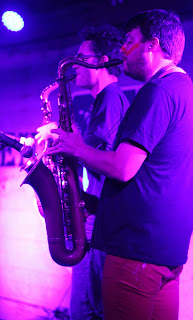
Quite perfectly, as it turns out.

From first note to final gasp, Garbus had the entire tightly-packed room in a state of elated hypnosis.  Accompanied by Brenner on bass and a Blues Brothers-channeling duo that alternated between saxophone and aluminum pan banging, Garbus shone like an imperfect and thereby infinitely more fantastic Princess Odette (the lead ballerina in Swan Lake—thanks Google). Or King Midas, since everything she touched—from her drums to her ukelele to a row of glass beer bottles to the pipes hanging from the ceiling—turned to sonic gold.

Best of all, however, was her voice itself.  Soulful, funky, and unabashedly eccentric, Garbus’ miraculous vocal chords can transition from a tribal howl to an earnest croon to a low pitched growl to a piercing scream in the span of about one second.  Her expertise in live looping allowed her to build layer upon layer of vocals into an altogether stunning castle of sound, which would suddenly fall away to reveal the kind of self-effacing litotes that clench around your heart and jam it into your throat: “What if my own skin makes my skin crawl?”

Garbus’ true genius lies in her unending ability to build a magnificent sense of wholeness by gathering up and retaining the individual charm of a thousand sparkling pieces.  Tied up in everything she does is the kind of magnetic yet humble personality that could hold a room captive even without musical talent.  Barely pausing for breath after the final line of the night’s last song, Merrill announced that she’d had to go to the bathroom “soooo bad” since the beginning of the show.  Then she dropped the microphone, jumped off the stage, and ran through the crowd toward the public restrooms, shouting, “I CALL FIRST DIBS!” 

Darling, you earned it.


Wednesday, September 28, 2011

Chromeo at Masquerade (Atlanta, GA)

What do you get when you combine a tall and skinny Canadian Jew named Dave 1 with a short and tubby Canadian Arab named P-Thugg?  No, this isn’t one of those jokes about guys who walk into a bar, although it could be.  Rather, it’s the self-described “only successful Arab/Jewish partnership since the dawn of human culture”: Chromeo.

This electro-funk duo is so damn lovable—from their sitcom-esque disparities to their earnest lyrics to their catchy melodies to the palpable sense of enthusiasm they exude on stage—that one simply cannot have a bad time at one of their concerts.  Even if the venue is devoid of air-conditioning on a particularly sticky night in Atlanta, and the people around you smell like they made a group decision that deodorant may cause cancer and should not be worn.   

At Masquerade on Thursday evening, after a bout of similarly endearing and surprisingly great white-boy soul from opener Mayer Hawthorne, it was time to get the party started.  The crowd—a diverse group of everyone from the polo-wearing UGA contingent to the ATL scenesters to the highly enthusiastic 50-something lady who was getting her groove on right next to me (this review is dedicated to you, madam!)—was visibly amped, diving into the “CHRO-ME-O, OHHHH-O” chants the moment the stage crew brought out the light-up leg keyboards. 

Finally, the impressive array of colored lights began to flash, and the duo emerged, dressed in outfits (Dave 1 in tight-fitting skinny jeans and Wayfarers; bearded P-Thugg in an open vest with his Buddha belly proudly spilling out of it) that only intensified their resemblance to non-evil versions of Aunt Spiker and Aunt Sponge.

What followed was an all-out electric funk-fest, with Dave 1 schmoozing it up on guitar and vocals and P-Thugg unabashedly voiceboxing and synthesizing up a storm.  From “Needy Girl” to “Tenderoni” to “Momma’s Boy” to “I’m Not Contagious”, the duo rocketed through a catalogue of greatest hits from their three LPs (2004’s She’s in Control, 2007’s Fancy Footwork, and 2010’s Business Casual) and had the whole crowd dancing throughout.  They paused only to deliver a heartfelt tribute to their friend and peer, the recently deceased DJ Mehdi, with whom they worked on the song “I Am Somebody” a few years back.

The show ended with a shower of silver confetti, which seemed perfectly designed to coat our sweaty bodies in Dalmatian spots of glittering mylar.  A successful evening, indeed.


Review and Photos by Hilary Cadigan


Monday, September 26, 2011

Countdown to Moogfest: An Interview with AC Entertainment's Director of Connectivity, Jeff Cuellar

By Hilary Cadigan


Robert “Bob” Moog, according to Wikipedia, is not only the inventor of the Moog synthesizer but also an American pioneer of electronic music.  But in today’s fast times, where the looming behemoth of electronic music has become such a standby that even the subcultures surrounding it are starting to feel mainstream, one might wonder if anyone is paying attention to how it all began. 

Bob Moog
In an era where few people have any idea how to even pronounce Moog’s name (answer: it rhymes with “vogue”), turning a historic legacy into something that modern music fans can not only acknowledge but also celebrate is not an easy task.  But if there’s anyone that could rise to the challenge, it’s AC Entertainment, the Knoxville, TN-based promotion company in charge of none other than Bonnaroo, one of the biggest and most popular music festivals in the country.

In a phone interview with Jeff Cuellar, AC Entertainment’s Director of Connectivity, I got the full scoop on the company’s newest brainchild: Moogfest, the three-day, eight-venue music and arts festival that he and his team created in response to this challenge.

Moogfest began in 2005 as a small, one-day event in New York City that sought to pay homage to Moog’s original followers.

“It was a great event, but the organizers at Moog Music came to us because they didn’t feel like it was hitting the mark,” Cuellar explained.  “It was more like a flashback than a flash forward, and we wanted to change that.”

According to Cuellar, the rebirth of Moogfest was based on one simple question: “How can we take the vision of Bob Moog and make it into something people can experience right now?”
For Cuellar and the AC Entertainment team, that meant showcasing the industry’s current innovators, artists whose work embodies Bob Moog’s legacy every day.

“I’m talking about genre-bending music, a sound-splicing way of pushing the boundaries, artists who are testing the limits, coming up with new sounds people haven’t heard before, challenging what music can do, mixing art with soundscape and creating a great live show overall,” he said. “At AC Entertainment, we’re connoisseurs playing off our palates.  When it comes to selecting musicians, at this point, it’s just something you know. Flaming Lips? That’s Moogfest. We’re keeping our finger on the pulse, knowing what’s new out there while also letting our fans know about older stuff, like Tangerine Dream and Suicide, bands that put a stake in the ground to allow for newer bands like Neon Indian and Washed Out. It’s not genre specific—we’ve got everything—it’s about the sound.”

And so, the new and improved Moogfest was born, complete with a newfound location—Asheville, NC—the place Bob Moog called home for the last 30 years of his life. 

Asheville is a unique place,” Cuellar said, “Perhaps it’s the mountains, perhaps its the people, perhaps it’s just the great food, but it all adds up to one of the most halcyon settings known to man, and ties together a beautiful package for a perfect weekend. In Asheville you can fully engulf yourself into the city itself—Downtown is walkable and unbelievably hip, the people love live music—we’ve got something amazing to be tapped into and a culture that supports it. It’s truly the perfect setting for an event like this, and the hometown response has been incredible.”

Asheville will also provide the site for the East Coast debut of Brian Eno’s newest labor of love: 77 Million Paintings, which Moogfest’s website describes as “an evolving sound and image collection born from his continuous exploration with light and the aesthetic possibilities of generative software.” According to Cuellar, the exhibit “utilizes several flatscreen televisions and culminates in an endless kailodscope of imagery that is both thought-provoking and inspiring. It’s not something you glance at and walk away.  It makes you want to sit down and debate the perils of life.” 

77 Million Paintings has only been shown in California so far, but Cuellar says that Asheville’s YMI Center, where it will be displayed throughout Moogfest weekend and up until November 30th, has such cultural relevance, that it “adds a mind-blowing mix of new and old that has been inspiring even for Brian Eno and his team.”

Ultimately, that mind-blowing mix of new and old seems to be the backbone for Moogfest as a whole.  With emphasis on the mind-blowing. So join me in Asheville on Friday, October 28th, and, as Cuellar says, “get ready for a trip to the fourth dimension!”

For tickets and additional information, visit http://moogfest.com/.


Wednesday, September 21, 2011

Music Midtown Returns to the A!

This weekend, Atlanta's Piedmont Park will once again provide a site for one of Atlanta's best-loved--and most missed--events of the year: Music Midtown!

Join me on Saturday, September 24, 2011 for short but sweet line-up that spans 2 stages and includes big-name acts like Coldplay and The Black Keys alongside local favorites like The Constellations.

Tickets are on sale now for $55.  Click the link below for more information and stay tuned for a full review!

http://musicmidtown.com/

Wednesday, September 14, 2011

Manu Chao at Masquerade Music Park (Atlanta, GA)

By Rob Royall

Manu Chao, on his La Ventura tour, made his Atlanta debut on a perfect night at Masquerade Music Park last weekend. The French-born, Barcelona-dwelling musician has been lighting up crowds with his latin-reggae-ska-punk amalgamation in Europe and South America since the 1980s with bands Mano Negra and Radio Bemba Sound System. Only in the last decade has he begun to achieve recognition in the U.S., highlighted by appearances at festivals like Coachella and Bonnaroo. Word has gotten out that he puts on one of the best live shows around, and on this night, the crowd appeared well-informed.

With a setting sun on the city's skyline as the backdrop, The Masquerade's back yard music park made the perfect venue for the night's performances. The crowd of a few thousand was treated to an upbeat opening set of roots reggae from local outfit The Rocksteady 5. It was a good primer for what was to come.

It should be noted to those who know Chao's studio albums -- but have never seen him live -- that these are two vastly different experiences. His albums may inspire you to go relax by the pool, while his concerts may inspire you to start a revolution. While Chao's multilingual lyrics are full of left-wing politics, it's more the emotion of the performance that gets people moving. The band came out and immediately got the crowd hand-clapping to a groovy reggae number. The feel-good mood quickly turned to feel-great when they abruptly transitioned into speedy ska punk, replete with fist pumping, chanting, and call and response. This slow-fast-slow-fast formula became the norm for the entire show, as the band never settled for long into any style. Over and over the crowd was wooed by soothing, acoustic guitar-driven world music, then worked right back into a fervor by the pounding rhythm section and racing guitars.

Radio Bemba Sound System has been known to include as many as 12 members on stage, including horns, keyboards, and accordion. But, backed by a stripped-down group of only bass, drums, and lead guitar, Chao was more than able to flex some muscle and make the show feel bigger than it was. This was aided by great stage presence, with all band members singing/chanting along, and the awesome guitar work and oft-cartoonish showmanship of sideman Madjid Fahem. Chao himself showed no signs of being 50 years old, while jumping around stage shirtless for most of the night and frequently beating the mic on his chest.

The crowd was appreciative and enthusiastic throughout and were responsible for one of the show's true highlights. During one particularly energetic song, a handful of fans made it up onto the stage and began hopping around and hyping up the band. Predictably, security made an effort to remove these guys from the stage until Chao motioned to them that it was OK. This led to upwards of 30 other people deciding they should join, and the band only played louder and faster, enthused by the onrush and the encouraging cheers of the rest of the audience. This lasted approximately 10 minutes and was a great show of kinship between a band, its loving fans, and a cooler than expected security crew.

Shortly after, the band left the stage, but they quickly returned for a long encore that left the audience more than satisfied. The group may have a tendency to repeat its best elements too often throughout the show, and would benefit from the more varied sounds other instruments offer, but nonetheless give an unforgettable performance. It is clear that Manu Chao and his band love what they do, creating an infectious quality that helps make this and any of his tours a can't miss. 

A Tribute to Amy Winehouse

By Patrick May

Where does one start when talking about Amy Winehouse? It makes
sense to start off addressing the tragedy that was her life, the international
fame and relationship problems that led her down a dangerous and
ultimately fatal path. Amy wasn’t made to be a star, she was made to love
and to be a musician. It’s important to first acknowledge her troubles, if
only to get them out of the way. They have nothing to do with Amy and her
musical legacy.

As a lover of soul music, I am often unimpressed by the majority
of throwback soul records that come out every year, attempting to
recapture “real” music but coming off as cheap imitations. I’m talking to
you Joss Stone, Duffy and even you, Adele. None of these women even
remotely touches the level of genius that Amy possessed. On her first
album, Frank, she showed us she could sing and write a kick ass song, on
Back to Black, her second and last, she showed us that she was a musical
movement.

Back to Black was not just some British girl pretending to have soul;
it was a revolutionary reworking of old school Motown arrangements
from the 60s, with the hip hop swagger of the 90s, sung in the style that
Dinah Washington and Sara Vaughan made popular in the 50s. All of this
coupled with Amy’s blunt, humorous, painful and eye opening observations
about real life made for a perfect storm of a record, an instant classic.
When she sang, she often looked off into the distance, seemingly unaware
that the best voice of our generation was coming from her. She created
magic simply by opening her mouth and her seemingly oblivious stage
behavior made her seem like a musical inevitability, something that had to
happen. It didn’t have to, but we’re so lucky it did.

Amy Winehouse sang her brilliantly poignant lyrics with the same
nonchalance, taking her musical statement to a new level. They
transmitted the feelings of a woman who was suffering breakups and
crushes and frustration in a way few can do. Each word was given intense
weight, and the jazzy way she strung them together made the listener
double-take: “wait, did she really just say ‘kept his dick wet?’” She did.
And it sounded amazing. And above all, it was truth! Some men are
unfaithful, most keep their dicks wet, some men look at you adoringly
while others “lick [their] lips as [you] soak your feet.” Her way of discussing
relationships—and sex—was so human that it hurt sometimes. When
she sings “I stay up / clean the house / at least I’m not drinking / run
around just so I don’t have to think about thinking,” the picture is clear and
identifiable: we’ve all been there.

That was Amy’s legacy; using the music of the past and the language of
now to create music that makes our modern day troubles seem timeless
and just as important as Aretha’s or Etta’s. Amy was self aware and
vulnerable, but brutishly so. Anyone who listens to her music can tell that
she was a sensitive person who felt deeply and lost herself to everything
she did, whether it was writing autobiographical lyrics, falling for Blake
or ingesting entire pharmacies worth of drugs. On her first album she
sings, “I’ll take the wrong man as naturally as I sing,” a lyric she surely
had no doubt would go on to define her life and her career. Maybe no
one can really sing like that unless they feel as much as she was feeling.
Amy communicated her darkness through her golden, glowing voice and
created fireworks on records and disaster in the streets of Camden. She let
everything in, and in the end, all of it took her out.

Rest in peace, Amy.

Tuesday, August 2, 2011

Glitch Mob at Masquerade 7/15/11

By Hilary Cadigan

FLASHING FLASHING LIGHTS LIGHTS BASS BASS BASS.

If you asked me for a seven word review of The Glitch Mob’s show at Masquerade in Atlanta this past weekend, that would be it.  Unfortunately, my actual word count requirement is a bit higher than that, so I will try to dig through the layers of glowing, pulsating bliss to eke out a slightly more comprehensive account of Friday’s extravaganza. Here goes.

With their seemingly effortless ability to hit a genre-defying sweet spot between hard-hitting hip-hop basslines and cinematic electronic noise, Glitch Mob has created their own brand of raucous dance music with a metallic edge, a more sophisticated precedent for the ubiquitous Dubstep scene that reigns today.

Since 2006, this Californian trio (formerly a quartet—founding member “Kraddy” left the Mob behind in 2009 due to “creative differences”) has been burning up dance floors and blowing minds at clubs, music festivals, and underground raves across the globe.

On stage at Masquerade, after a mysterious last-minute venue changeover from King Plow Arts Center in Westside, the evening began with two perfectly selected openers to get the crowd warmed up in doses.  First came chillwave wunderkind Com Truise, who we unfortunately just missed.  We arrived just as New York-based trip-hop duo Phantogram took the stage, masterfully melding the woozy, haunting vocals of keyboardist Sara Barthel with scratchy-smooth melodies and mesmeric beats.  My only complaint about this performance was for the sound guy—the vocals were often drowned out by the music, which was a shame given how excellent they were.

Then, it was Glitch Mob time. Against a pulsing backdrop of multi-colored LED squares, the three DJs, “edIT”, “Boreta” and “Ooah”, collaborated behind three individual turntables bedecked with their trademark LED light squiggles.  And, from there on out, it was a non-stop dance party.

Glitch Mob had the crowd simultaneously entranced and unable to stand still as the unstoppable trio churned out a seamless sequence of back-to-back gems, from the industrialized groove of “Animus Vox” to the orchestral bleeps and blips of “Fortune Days” to the grand whir and boom of “Drive It Like You Stole It”. The set list, comprised almost entirely of original material, included the majority of their latest album, this year’s excellent Drink the Sea.  And when the Mob did venture outside of their own catalogue, the results were nothing short of spectacular—an explosive rendition of “Seven Nation Army” had the whole crowd screaming and stomping along.

All in all, a seriously great evening. I only wish it could’ve lasted longer.
Free counters!