Showing posts with label ultra music festival. Show all posts

Wednesday, April 6, 2011

ULTRA MUSIC FESTIVAL 2011

Miami’s Ultra Music Festival is not exactly a model citizen in the world of music festivals.  It’s no Burning Man, no Woodstock, not even a post-Kanye Bonnaroo. There’s no overt mission of sustainability or charity aside from the rather half-assed “Eco Village” shoved behind the Heineken Dome in the back corner of the park. The food options are narrow, unhealthy, and wildly overpriced ($15 for a sub-par plate of chicken fingers and a handful of undercooked fries? Yikes).  The bathrooms are few and far between (waits reportedly lasted up to half an hour). There’s no source of free water, which is a huge no-no in my book (water = survival when it comes to spending all day dancing in the hot sun, and forcing parched, Molly-driven ravers to pay $5 cash for every puny bottle is downright lethal). There wasn’t even a recycling facility (come on).

Bienvenidos a Miami.

Then there were the unexpected and unintentional issues: a massive and very poorly timed fuel fire at the Miami airport that canceled nearly 200 flights; scheduling conflicts with the Winter Music Conference, Swedish House Mafia’s “Masquerade Motel” show, and Chromeo’s performance at the Juno Awards; Bicentennial Park construction that forced organizers to make do with a venue size 30% smaller than last year’s…

And yet, wow. UMF 2011 triumphed.

At a time when many festivals focus on drawing in the maximum number of people with the widest variety of musical offerings—the “something for everybody” approach—Miami’s Ultra Music Festival seems to have known exactly what it wanted to be since its nativity on the shores of South Beach thirteen years ago.  Despite or rather because of its complete unwillingness to compromise on this very particularized vision, Ultra seems to have achieved self-actualization in a way that few other festivals have in this day and age.  The result? A three-day, sold-out wonderland of bass-laden, booty-shaking, face-melting EDM that showcased the very best of an industry in its prime.  With a line-up ranging from hot-off-the-press buzz-makers (Afrobeta, Beardyman, Trentmoller) to legendary standbys (Chemical Brothers, Carl Cox, Underworld), Ultra ran the gamut without ever veering too far from its molten core.

I guess what I’m trying to say is that Ultra Music Festival is not for everybody.  But it is for anybody who loves electronic music enough to be blasted with it for three solid days without reprieve. And therein lies the beauty of the whole affair. 

FRIDAY:

We arrived to find the party in full swing, with what would soon prove to be a permanent sea of speedy die-hards blanketed across the mouth of the Main Stage and shaking their fists along with the endless pulsations of Benny Benassi, who seemed to take his midday placement as a chance to chill out, and was even spotted texting onstage during his own set.  Not that it mattered; crowds were way too amped-up to notice, and it’s unlikely that anyone who noticed would have cared anyway.

After checking out the scene a bit, we skipped over to the Live Stage, Ultra’s second biggest and best situated arena, where Norwegian downbeat duo Röyksopp was spinning some seriously spellbinding ambience that kept everybody moving.

Next up, an entirely unexpected and seriously danceable dubstep-derived nosh-up from classically trained house mastermind BT (a.k.a. Brian Transeau).  It was exactly what I’d been looking for all evening, with my energy level still sky-high and booty aching to swivel and swim.  BT would be playing a second set on the Main Stage on Sunday afternoon, but unfortunately it was scheduled for 1:30 p.m., hence I already knew I wouldn’t be making it unless I happened to wake up there.  Regardless, despite the small stage size of his Friday set, it was clear that this British club favorite and all-star producer knows how to deliver exactly what the people want, exactly how and when we want it.

Rave-style hypnosis.
We were riding high until we headed back to the Main Stage, which was all but deserted thanks to the Duran Duran buzz kill that was happening on it.  This is not to say that Duran Duran is not worthy of a listen, or that they shouldn’t be applauded for making a comeback, or that their rendition of “Notorious” didn’t put a smile on my face, it’s just that they didn’t fit in with the otherwise airtight line-up that Ultra created, and it was too early in the weekend for people to be ready for a break from the pulsing electro we had come to experience.

Then, right when we began to wonder if live sets were a no-go at Ultra, here came Pendulum, with epileptic, industrial noise layered under live drums and vocals alongside skin-crawling big-screen visuals that brought the energy and the crowds bouncing back to Main Stage. 

When Pendulum got overwhelming, it was over to STS9 for some downtempo electrojams and a rare break in the pulsing base. But you can only sit for so long at a place like this, so we ran over to Tiesto, god of trance, who’d come all the way from the Netherlands to hypnotize 50,000 of us into a state of pure euphoria.  Now that’s a great way to kick off a weekend.

EMTs can party too.
SATURDAY:

We rambled back over to the festival grounds just in time to catch Dutch dance DJ Afrojack, who has been drawing quite a bit of buzz lately for his ability to take crowd-pleasing pop songs and amp up their danceability factor by about a thousand.  When we arrived, he was doing just that to an already thoroughly sweaty crowd at the Main Stage.  Even the EMTs constantly roving the crowd picking up ravers who raved too hard were partying on their EMT mobiles.  We immediately joined in. 

Suddenly, we looked up to see a plane tracing out billowy white smoke letters across the cloudless blue sky: L... A… D… Y… It was like that scene in Matilda where the whole classroom of kids is reading out Magnus’ chalkboard message to Miss Trunchbull from beyond the grave (right? Anyone?  Never mind).  G… A… G… A… Suddenly you could feel the communal energy shift, everyone staring at the sky, cameras pointed, breath bated.  This was by no means a crowd of teenyboppers or Lady G diehards, but the woman’s a superstar, and a surprise appearance, we all agreed, would be epic, indeed. But no.  It was just a promotion for B…O…R… oh.  Born This Way. S a bag of D’s, Gaga.  The only way I’ll be obtaining your newest album is by pirating it.

Next, on the Live Stage, Simian Mobile Disco duo James and James (Ford and Shaw, respectively), clad in simple all-black ensembles, fully embodied their own indie-tech duality by producing a hip-shaking lesson in sleek and shiny minimalism via clunky analog DJ equipment that looked like something David Cronenberg might’ve dreamed up in 1983.  Hipsters and ravers: two birds, one stone.

As late afternoon seeped into early evening, my crew and I formed something of a disco train that bumped and grinded through seas of sweaty, smiling, dayglow-swathed revelers before pausing in the central dustbowl to rock out to San Fran house master Kaskade.  Kaskade’s always-awesome assortment of expertly-fused party tracks includes everything from classic dance riffs to spanking new samples from dub’s newest it-kid, Skrillex, whose own performance was regrettably missed by me.

From there, it was over to the multi-level Carl Cox & Friends arena, a brand new addition to UMF and “the largest enclosed sound structure ever featured in Florida.”  Here, spinning his heart out, was one of the most controversial figures in techno—although you definitely wouldn’t know it by the looks of him.  Quintessentially bald and bespectacled, this would be Moby, the guy who made electronic music mainstream in the early 90s, and who continues—as he proved on Saturday—to stay at the zenith of the game, churning out electric dance magic as vigorous as it was dynamic, as classic as it was fresh.

Bright like neon love.

 Then, it was time to head back over to the Live Stage, where two of the acts I was most looking forward to were scheduled back to back: Cut Copy and Empire of the Sun.  Unlike distant cousins Simian Mobile Disco, Cut Copy occupies an entirely different section of the indie-electro soup.  Actually, picture that soup as one of those kinds you can get in Asian restaurants that’s shaped like a yin yang, and think of Cut Copy as the yang to SMD’s yin.  Whereas SMD surfaced as a paring down of experimental electronic rock band Simian, Cut Copy evolved out of DJ/producer/songwriter Dan Whitford solo project, to which he added bassist/guitarist Tim Hoey and drummer Mitchell Scott to fill out his synth and sample-based sound. The pre and post-addition album titles say it all: “I Thought of Numbers” transformed into “Bright Like Neon Love,” a phrase that accurately sums up the band’s performance on Saturday, despite the fact that their set list drew most heavily from their two latest albums, indie-darling “In Ghost Colours” and this year’s equally awesome follow-up, “Zonoscope.”  Regardless, the band kicked off a welcome hiatus from the rotations with some good (albeit not so old-fashioned) live music that had crowds dancing and singing madly and brightly as neon love itself.

Empire of the Sun
If Simian Mobile Disco and Cut Copy are a yin-yang shaped soup, Empire of the Sun is on another plate entirely.  And by plate I mean planet.  (I know, that was a good one.) With their experimental yet pop-minded electric revival, the Aussie duo’s music sounds much like that of American counterparts MGMT—that is, until you compare their live performances.  Completely blowing MGMT’s notoriously lackluster shows out of the water, Empire of the Sun delivers exactly what you’d expect from a band whose album art resembles a space-age theatrical poster for Labyrinth. I have no earthly idea about the plot that unfolded onstage, but the mesmerizing spectacle of glammed-out costumes, interstellar backdrops, and Cirque de Soleil-style choreography left me far too entertained to care.


Next, we raced over to Main Stage to catch the tail end of what was clearly an incredible live set by British electronica veterans Underworld.  Luckily, the duo closed out with the soaring melodies and neck-breaking beat of “Born Slippy,” the song from Trainspotting that seems to best capture the gritty glamour and brash tragedy of the 1980s Edinborough club scene depicted in the film. The fact that this was one of Underworld’s last-ever performances made the experience particularly cathartic.

Deadmau5
To conclude Day 2, last year’s top headliner and the reportedly antisocial wunderkind of today’s EDM scene: Deadmau5, a.k.a. Joel Zimmerman.  Complete with a blinged-out version of his dementedly grinning mouse head and lit-up cube—notably brilliant elements that set him apart visually from the hundreds of other skinny white guys standing at turntables—Zimmerman spun his distinct brand of dark and bouncy techno for bouncing masses rife with homemade recreations of the Mau5’s iconic head.  Heavy on the bass, heavy on the synth, heavy on the flashing lights.  
Deadmau5 has a real person face.

Zimmerman’s bromance with Tommy Lee continued as Lee and his drum kit emerged on a raised platform, and Lee’s girlfriend Sofi Toufa (as in, the one who needs a ladder) strutted around below and yelled into the microphone, alternating between what some might describe as singing and what most would describe as prattling on when all we want to hear is the music.  At the end of the show, a blizzard of confetti shot out into the crowd, the lights went white, and we all trudged back to our respective hotels, condos, and, as the case may be, all-night after-parties that kept the city throbbing ‘til the sun came back up.

SUNDAY:
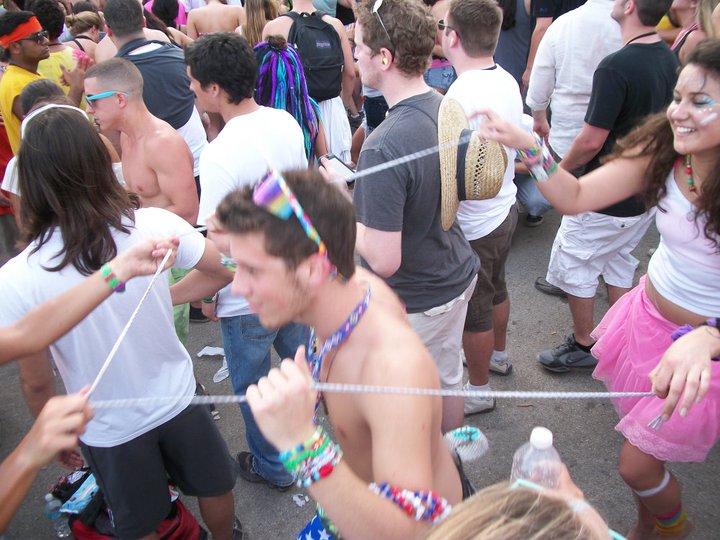

Sunday was spent flitting around like moths to a series of flames (the flames being any beat we could shake to), in a dance trance that didn’t stop until the music did. It began with an electro-house stopover at Wolfgang Gartner but quickly moved into an official State of Trance.  And by this I mean that for its third and final day, UMF decided to transform the Carl Cox tent into an enchanted grotto reserved exclusively for back-to-back performances from some of the greatest trance DJs in the world. 

Fake Blood
After getting down to British progressive trancer Gareth Emery, we scooted over to Live Stage to the beat-heavy house party of another talented Brit—Theo Keating, a.k.a. Fake Blood, a personal favorite that we’d first discovered at Ultra last year.  Despite his preoccupation with another music project called The Black Ghosts with Simon William Lord, Keating’s lively beats and computerized vocal hooks remain addictive as ever. 

A State of Trance.
We danced until Steve Aoki emerged and disappointed us all by eliminating the one thing we loved about him—his delicious Lion King intro.  And he didn’t even replace it with anything cool. So, the disco train left the station, and we made our way through twisting passages, grassy knolls, and strung-out hill-dwellers back to A State of Trance, where Armin Van Buuren promptly showed us exactly what the phrase meant.  Soaring synths!  Astronomic drops! Flashing lights! Rainbow glasses! Vick’s Vapo-Rub! Heart-melting rendition of “Use Somebody” that had the entire crowd singing along with our arms in the air!  When I emerged from the tent I felt I’d lost all five senses, and I wasn’t even mad.

The only thing that could tear us out of our tranced-out state was the Crystal Castles set happening back over at Live Stage, so away we went.  As you may know, I’ve already seen (and reviewed) Crystal Castles more times than necessary, and though I love them dearly, they’re pretty much the same every time: Ethan spins and Alice screams and everybody wears a lot of black. This time, Alice had a bum leg, so she couldn’t even crowd surf.  But I still danced my pants off. 

Not Beardyman, but a man with a beard.
Next up, something truly new and different: London-based beatboxer extraordinaire, Beardyman.  This guy is pretty incredible, folks—his entire show consists of off-the-cuff beatboxing and live looping technology.  As in, every sound that comes out of his speakers is a sound that he made with his mouth while he was standing there in front of us.  You’ve got to see it to believe it—it’s a feat admirable enough to forgive the shameless self-promotion in the form of Windows ‘95-style graphics that came along with it.  Expect to see big things from this up-and-comer.

After Beardyman’s 20-minute set (apparently he was a last minute addition), it was time for MSTRKRFT, the Canadian dance duo comprised of Death from Above 1979's Jesse F. Keeler and producer Al-P. With a slew of expertly crafted remixes and rollicking beats, these guys just know how to make people move, and we love them for it.

The Chemical Brothers
MSTRKRFT provided the perfect warm-up for what was without a doubt the most epic performance of the entire weekend.  The fact that it happened to be the top headliner performing the final set of the festival just goes to show how great UMF’s organizers are at their job.  Enter the pioneers of big beat; the original unifiers of dance, rock and rap; the granddaddies of arena-sized electronica: The Chemical Brothers. Living up to every expectation and then some, Tom Rowlands and Ed Simons put on the show of the century: back to back to back flawlessness, like a thousand moving parts all coming together into a perfect machine.  As mind-melting visuals flashed across the screens—a mechanical horse, a human body made of light bulbs, the most terrifying clown in the history of the world screeching, “YOU’RE MY CHILDREN NOW!”—sound and vision melded into one big bursting sensation that seemed to coat the inside and outside of every single body in the park.  Walls of blood-curdling sound seemed to reach down and scoop up the entire crowd by our earlobes, lifting us until it seemed like our ears would tear away from our skulls, and then at the last possible second dropping us back down into a featherbed of liquid beats, the kind that makes you look over at your friends and scream “OH SHIT!” into their beaming little faces.  Pure bliss.

Ultra = Bliss.

A confession: when it comes to music, I’m a hedonist.  I seek out sounds that bring me pleasure, that I can feel deep down in my belly, that radiate from my flailing limbs. This is why Ultra is so incredible to me—and also why it’s so difficult to capture it in writing.

Novelist Nick Hornby says, "I love the relationship that anyone has with music: because there's something in us that is beyond the reach of words, something that eludes and defies our best attempts to spit it out.  It's the best part of us, probably, the richest and strangest part."  In Ultra, we sum it up in just two words: “TOTAL FACEMELT.”
The End.

By Hilary Cadigan
Photo Credits: Hilary Cadigan, Rob Royall, Stacy Komitor

Sunday, April 4, 2010

Ultra Music Festival 2010 Review

Ultra Music Festival: a two-day extravaganza made up almost entirely of Electronic Dance Music.  Take a moment and think about that, two days—20 hours total—of dancing. And I’m not talking about your grandma’s foxtrot here, people, nor am I referring to the typical head-bobbing concert fare of yore.  I speak of sweaty, fist-pumping, hip-shaking, foot-stomping, neck-dislocating, all-out absurdity.  To be sure, one does not and should not come to Ultra unless they are ready to get extreme.


Unlike more typical music festivals (and I use the word typical very loosely here), the Ultra lineup does not cater to the general music-loving public.  Rather, it is very specific in its aim, and that aim is EDM. Ultra-goers came in all kinds of kooky outfits, from rainbow tutus to Green-Man-inspired bodysuits to banana costumes.   Anything neon or glowing was the norm.  The clientele bore a refreshing lack of pretension—there were the usual groups of friendly festie folks, crunchy kids, electro nuts, clubbers, ravers, rollers, and even a ferociously fist-pumping but otherwise harmless faction of guidos, but everyone seemed strangely at peace with each other.  Such is the magic of truly successful festivals, which Ultra certainly embodied, despite the lack of onsite camping.  I used to think that only living together as a temporary community could establish the kind of widespread camaraderie I found at festivals like Bonnaroo and Echo Project, but Ultra proved me wrong.  Sure we all went home to our respective homes, hotels, motels, couches or cars at the end of the day, but while we were there, it was all about the music and the sense of social cohesion it brings. No matter who we might’ve been individually, together we were all the kind of people who’d actually pay to subject ourselves to a 2-day marathon of nonstop bass lines and booty shaking, and there’s definitely a sense of solidarity in that.  Here’s my attempt at sharing that solidarity with you: a play-by-play account of my Ultra 2010 Experience.


FRIDAY:
Due to the combined forces of rush hour gridlock, a long wait at the press tent, an inexplicably early set time, and the potentially ill-advised decision to run all the way back up ten flights of hotel stairs to retrieve my collection of glowsticks, I tragically and shamefully missed the show I was most looking forward to: Pretty Lights.  As such, my Ultra arrival was slightly marred by frustration, but as I crossed into Bicentennial’s electronic wonderland of sound, I was able to recover pretty quickly and start focusing on what was yet to come. Entering to the right of the main stage, my friend and I were immediately enveloped in Passion Pit’s giddy crowd-pleaser “Better Things,” but determined to check out the scene, we managed to tear ourselves away from Michael Angelakos’ dizzying falsetto to take a look around. 


Directly in front of the rather sparsely populated main stage, the Ibiza Arena was already packed to the brim with punctual festivalgoers pumping along to the pulsations of DJ Laidback Luke.  It was overwhelming at first.  We dithered from one stage to the other, trying to assemble our troops (already scattered throughout the festival due to the separate entrances for general admission, will call, and press) and unsure of where or how to start our musical voyage before finally plunging into the Ibiza tent as Black Eyed Peas rapper Will.i.am took the stage. 

Let me be clear: I despise the Black Eyed Peas.  Just looking at Fergie makes me want to punch a baby in the face. However, due to the welcome exclusion of Peas abominations like “Big Girls Don’t Cry,” Will.i.am’s set quickly developed into a high-energy albeit rather typical affair of samples and remixes, including a “Don’t Stop Believing”/“Sweet Child O’ Mine”/“Thriller” sequence that got the crowd riled up enough to start climbing the suspension poles.  Pole-climbing became a common occurrence throughout the festival, and as each daring idiot clambered up and beamed down at the crowd as though he were the first person in history to reach such clever heights, I was actually reminded of how much I appreciate the lasseiz-faire nature of these types of events.  At Ultra, you don’t get punished for doing something stupid like climbing up a pole. If you fall, it’s your own damn fault.  The same goes for drugs; yes, drug-culture thrives at Ultra, but it’s by no means unavoidable or even all that perceptible for those who aren’t interested in it. Ultimately the choice of whether or not to take part is completely up to the individual—at Ultra, and other events like it, you can do and be whatever and whoever and however you want to be amidst a community virtually void of judgment.  It carves out a unique time and place of jubilant anarchy, where the typical and often arbitrary rules and taboos of society go out the window, and the crazy kids get to come out and play without fear, rediscovering a rare sense of human continuity all but lost in the tightly controlled system we live in today.


Anyway, my friends and I ducked out of Will.i.am’s set early to grab some soggy/overpriced festival food and then headed over to London dance duo Groove Armada’s scheduled live performance on the Main Stage.  But wait, this isn’t… who is this?  It was LMFAO, inexplicably coming on early and punishing our ears with a worse-than-usual rendition of “I’m In Miami Bitch” (this phrase became a kind of all-too-obvious theme for the festival, sampled in several other sets and plastered in Day-Glo on what appears to be this year’s most popular tourist t-shirt). The performance carried on exactly as you might expect from the people responsible for the Jersey Shore theme song as well as every other miserably catchy vocal hook on the frat party circuit these days (personal favorite: “SHOTS! SHOTS! SHOTS! SHA-SHA-SHA-SHOTS!”).

When they finally emerged, electro-pop outfit Groove Armada provided a welcome reprieve from the off-key assclownery and a healthy dose of estrogen amidst all the male energy dominating Ultra’s stages.  While Tom Findlay and Andy Cato have been grooving since the mid-90s, their most recent album, this year’s Black Light, debuted fearless female vocalist Saintsaviour, who carried the performance, marching onto the stage in a suit of sparkly armor and rocking out like some kind of alien empress.


We left Armada heading vaguely in the direction of Infected Mushroom, until I suddenly heard some seriously sick beats coming from the direction of what would soon prove to be my favorite area of the festival—the comparatively small but ideally situated Biscayne Stage, stationed in the very corner of the park and framed by a cluster of skyscrapers and what appeared to be Miami’s mini monorail track.  Plunging into the smallish crowd gathered in front of the stage, we were immediately sucked into the spellbinding throb of a DJ none of us had ever heard of before—Fake Blood aka DJ Touché. Remixing samples from Little Boots’ “Stuck on Repeat” and The Kills’ “Cheap and Cheerful,” along with original tracks such as “I Think I Like It,” Fake Blood expertly blended fidgety synth stabs and pitched-up vocal bits built to the brink of torment before surrendering to pounding baselines that got the whole crowd jumping.  It turned out to be one of my favorite sets of the weekend.

Due to the utter overabundance of Ultra’s lineup (given the chance I’d see every single act individually, but that would take months), we’d typically stick around for a few songs of each set and then look at our tattered pamphlets and sprint over to the next stage to check out a new scene.  We spent the 9:00-10:00 slot flip-flopping between two masters of house music: David Guetta and Kaskade.  French DJ Guetta is a perennial favorite of the club scene with boatloads of mainstream appeal, probably due to collaborations with radio rappers Kid Cudi, Akon, and Will.i.am (the latter, not unexpectedly, stuck around for a guest appearance on Guetta’s stage).  Guetta put on a show that revolved just as much if not more around visual spectacle as it did around music: the first in a series of late-night Main Stage headliners featuring mind-blowing collaborations of colored lights, long-range lasers, multi-screen visuals, and massive flame-throwers that sent waves of heat all the way to the very back of the crowd.  Kaskade, on the other hand, while certainly not lacking in the lights and lasers department, spun out dreamy pulsations that could’ve retained their allure in a cement prison cell. 


After working up a sweat in Kaskade’s tent, my crew and I decided to settle down for a welcome period of relaxed listening on a grassy hill next to one of the majestic white Heineken domes in the center of the park.  From there we watched as the masses gathered around Main Stage for the highly anticipated Tiësto set that would close out the evening. While just as danceable as that of Guetta or Kaskade, Netherlands-born DJ Tiësto’s music is rooted in trance, and despite the progressive nature of his eclectic samplings and collaborations, his mesmerizing ability to put audiences into a mobile yet trance-like state is worth mentioning.  Tiësto’s set got better as it went on, and eventually had us off the grass and into the fray, dancing wildly to the symphonic percolations of “Adagio For Strings” and the chill-inducing splendor of tranced-out Tegan and Sara collaboration “Feel It In My Bones.”  The two guys gallivanting around the stage in stilts and full-body light-up suits with guns that emitted billowing clouds of fog just added to the surrealism of the whole affair. 


SATURDAY:
Day 2 began at noon, another sunny portrait of meteorological perfection.  We arrived at Bicentennial to find a sold-out venue—apparently the 100,000-person capacity had actually been reached.  Scalpers were selling Saturday-only tickets for up to $400 (originally a 2-day pass cost only $140). Planning ahead never felt so good.

Our first stop of the day was Diplo at the Bayfront Live Stage.  One half of Major Lazer, which had a separate set later in the day, Diplo aka Wesley Pentz is clearly a man who knows his craft.  Dressed in a Major Lazer t-shirt, the unflappable Pentz mixed and mashed a variety of different samples and syncopations, including the absurdly infectious hook from Lazer’s “Pon de Floor,” while infusing it all with his characteristically bouncy Floridian vibes. 


Post-Diplo, in the process of mobilizing for the Damian Marley/Nas set over at Main Stage, I was suddenly struck motionless as the opening vocals of a very special song came blaring over DJ Steve Aoki’s speakers: it was “Circle of Life,” as in that marvelous opening song from The Lion King where Rafiki holds baby Simba up in the sky at the tip of Pride Rock and all the lions cheer (I was thus inspired to look up the lyrics—apparently they are “Nants ingonyama bagithi baba, sithi uhhmm ingonyama” which means “There comes a lion, oh yes, it’s a lion.” You learn something new every day). The Circle continued with a charming remix stratified with jungle beats that had the crowd going wild, but my troops were on a Marley mission, so I had to bid farewell just as the Kid Millionaire was launching into a spontaneous head-banging dance and screaming in a sinister way over what must have been a pre-mixed track.  Ah well, a good time to move on.

At the Marley/Nas show, I was most delighted to find that the unrelenting flag-waver I remembered from Damian’s concert circa 2007 was still waving in full force.  If you’ve ever seen a Damian Marley performance, you know what I’m talking about, and if not, you should, because it is awesome. Marley’s affable mix of Jamaican charm and scintillating rhymes effortlessly arranged over reggae/hip-hop harmonies is the perfect soundtrack for a sunny day in Miami.  Nas’ hard-hitting urban eloquence adds another pleasing layer to the Marley marvel—the comrades’ musical and cultural solidarity shined brightly throughout their performance, inciting further anticipation for their long-awaited collaborative album Distant Relatives, due for release later this month.


The next stop of our meandering musical journey was the tiny Day-Glo Arena, which advertised the world’s largest paint party.  Clearly, I needed to get involved.  We spent the next half hour dancing madly to the house beats of various smaller-name DJs as armed performers in plasticine suits sprayed us with neon paint.  It doesn’t get much better than that.

Once we were thoroughly doused in Day-Glo, we headed back over to the main stage to check out neo-electro dance DJ Benny Benassi, where it was easy to see why Benassi is such a sensation.  The epileptic revelry of throbbing beats and screeching synthesizers—particularly in hit single “Satisfaction,” with its “Fitter Happier”-inspired computer voiceovers—really epitomized Ultra’s overall atmosphere.

I spent the next few hours over at my beloved Biscayne stage, where a series of back-to-back dubstep sets was already in full-force. A London-based offshoot of U.K. garage that employs elements of drum'n'bass, techno, and dub, dubstep has a kind of dark but thrilling intensity that really cuts to the heart of EDM greatness.  The line-up progressed from Benga to Caspa to Glitch Mob to Skream! to Rusko, and while I tended to drift in and out of these performances, there was something special about the cohesion of the crowds that gathered for these sets.  From the hill next to the stage, I had a perfect view of all the tightly packed bodies jumping in unison with their hands in the air as the Miami sun began to set, flooding the sky with rose gold. 


Next on the Main Stage was progressive trance DJ Armin Van Buuren, another Netherlands native with worldwide acclaim whose sprawling compositions and breathtaking lightshow seamlessly carried the frenzied masses from day to night.  Van Buuren and Tiësto share a number of similarities, and collaborated in the past with the hit “Eternity.”

Soon it was back to Biscayne for more back-to-back goodness.  First up, Bassnectar, self-described as “A free-form project that merges music, art, new media, social involvement, and community values; dedicated to a constantly evolving ethos of collaborative creation, self reinvention, and boundary-pushing experimentation."  That statement may contain some bullshit, but with his trademark waist-length dreads and exuberant head bobbing, Bassnectar is a force to be reckoned with and a personal favorite of mine.  His quirky mix of tripped-out ambience and hard-rocking techno beats stands out even in this sea of other talented electronic music-makers.


Ultra’s quick turnaround between artists was both consistent and admirable. Accordingly, as soon as Bassnectar shuffled off the stage, a bunch of new people jumped on.  This motley crew of costumed dancers came to start the all-out dance party featured on Major Lazer’s set.  This newly established digital reggae/dancehall project has received much critical acclaim and indie cred since the Summer 2009 release of Guns Don’t Kill People… Lazers Do.  The innovation of DJs Diplo and Switch, Major Lazer features Gorillaz-esque cartoon characters complete with an absurd back-story (something involving limbs lost in the secret Zombie War of 1984), and mixes a range of Jamaican musical elements with tight beats, catchy refrains, and a slew of guest vocalists, from Santigold to Mr. Lexxx.  Their set was a paradigm of pure fun, with vocalist Skerrit Bwoy and a troop of female dancers infusing an extra layer of personality. Oh, and the snappy hook featured in “Pon de Floor” is still stuck in my head.

Finally, yet all too soon, we entered Ultra’s final hour: Deadmau5, Paul Oakenfold, Ghostland Observatory, and Carl Cox were all performing at the same time on different stages.  Tough decisions had to be made.  I started out with Deadmau5 on Main Stage, where the entire area was so packed that oxygen seemed like a luxury.  So, I took the lack of oxygen and the Mau5’s underwhelming intro as an excuse to round out my trifecta of Ghostland Observatory experiences and headed over to the far more breathable Bayfront Live Stage at the other end of the park.


Ghostland did not disappoint.  While their set seemed suspiciously brief (no sign of “Silver City,” a personal favorite), roguish frontman Aaron Behrens lived up to his Freddy Mercury/Prince associations as he shrieked and gyrated amidst the smoky technicolor of a laser light show spectacular enough to rival those featured on much larger and infinitely more populated stages.  The layered perfection of thumping bass, crunchy guitar riffs, and silky synth hooks featured in “Midnight Voyage” extended into a full-on electro-jam session, held down by producer/drummer/synther Thomas Turner in his requisite floor-length cape ensemble.  Ghostland’s vivacious performance was a perfect amalgamation of all the various subgenres that Ultra promotes, and a preview of the places EDM can and will go as it continues to develop.  In other words, a perfect way to end an incredible weekend.


Review & Photos by Hilary Cadigan
Free counters!